
By Emma Rowland, Gaylord News
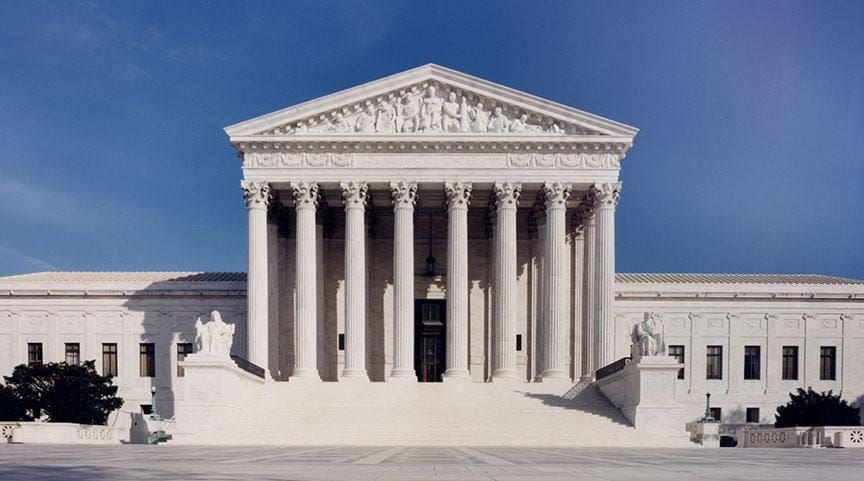
WASHINGTON – The U.S. Supreme Court declined to hear the appeal of a Native American woman, leaving in place an Oklahoma Supreme Court ruling that narrows how the court’s landmark decision in McGirt v. Oklahoma applies in civil matters, particularly state taxation of tribal citizens.
The denial confirms the state court’s conclusion that Oklahoma may tax certain tribal members who live on unrestricted, non-trust private land, even if they work within tribal jurisdiction.
The decision in Stroble v. Oklahoma Tax Commission underscores concerns raised in a 2020 dissent by Chief Justice John Roberts, who warned that McGirt could create “significant uncertainty” over state authority in areas touching Indian affairs.
In McGirt v. Oklahoma, the Supreme Court held in a 5-4 decision that Muscogee (Creek) Reservation remains “Indian Country” for purposes of federal criminal law, rejecting arguments that Congress had never established a reservation or had effectively disestablished it. However, the ruling addressed criminal jurisdiction and did not resolve how its definition of “Indian Country” would apply in civil contexts such as taxation.
That unresolved question was central in the case of Alicia Stroble, a citizen of the Muscogee (Creek) Nation. Stroble argued that Oklahoma could not tax her income because she works within tribal trust land and because McGirt clarified the boundaries of “Indian Country.” She sought exemptions for tax years 2017 through 2019 under state rules exempting qualifying tribal members who both live and earn income within tribal jurisdiction.
The Oklahoma Tax Commission rejected her claim, finding that although Stroble met some requirements, she did not live in “Indian Country” because her residence is on unrestricted, non-trust private land. The Oklahoma Supreme Court affirmed that decision in a 6-3 ruling, relying in part on Oklahoma v. Castro-Huerta (2022), which emphasized the state’s authority over its territory unless preempted by federal law.
Governor Kevin Stitt said the decision provides clarity on the scope of McGirt v. Oklahoma and reinforces a consistent framework for taxation across the state, calling it “about fairness for all four million Oklahomans.”
“This is about fairness for all four million Oklahomans,” said Stitt. “Time and time again, the courts have limited the McGirt decision, rightfully upholding state jurisdiction. This decision made it clear that someone’s tax bill will not be based on their race.”
Cherokee Nation Attorney General Chad Harsha, in a statement wrote: “The Cherokee Nation is disappointed by the U.S. Supreme Court’s decision today declining to review Stroble v. Oklahoma Tax Commission, a flawed state court ruling that is inconsistent with federal law precedent and an attempt to minimize tribal sovereignty.
“There is clear law surrounding the taxation of tribal citizens living and working on tribal land, and the Oklahoma court’s decision ran counter to those policies.
“The proper way forward is to tackle our shared priorities together while respecting treaty rights and state and federal law,” wrote Harsha. “Tribal nations make Oklahoma strong and invest millions of dollars into our roads, schools, law enforcement agencies and other services, and we are committed to working with our state and local partners to continue to do so in a manner that respects the law and tribal sovereignty.”
Gaylord News is a reporting project of the University of Oklahoma Gaylord College of Journalism and Mass Communication. For more stories by Gaylord News go to GaylordNews.net.