
By Alexandra de la Mora, Gaylord News
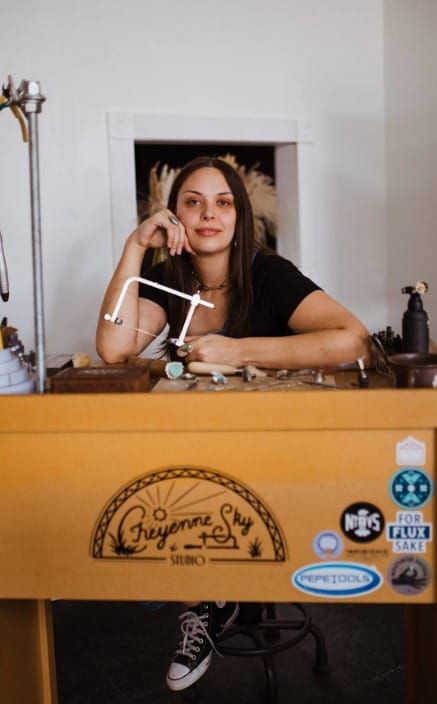
WASHINGTON – Taylor Martin, Chickasaw and Seminole Native, wife and mother, started her silversmithing studio, Cheyenne Sky Studio, in 2023 despite not obtaining financial support.
“I had to take it upon myself to decide to open the studio. I didn't have savings or funds or anything to allocate towards it,” Martin said. “There's not a lot of opportunities for loans, and occasionally you could get a grant, but even those are kind of hard to come by, so you just kind of have to figure out a way to fund your business.”
The Native American Entrepreneurial Opportunity Act, first introduced in 2021 by Kansas Rep. Sharice Davids, a Native American Ho-Chunk tribe member, could solve that. Davids has reintroduced her Act in every Congress since then. It is now poised to become law if Davids can get the support she needs for it to be adopted by the Senate.
This act will help connect Native business owners with resources offered by the Small Business Administration, building entrepreneurial development, according to the report.
The Small Business Administration’s Office of Advocacy estimated in 2024 36,116 Native American-owned businesses were operating in Oklahoma, of which 32,000 were sole proprietors with no employees other than the owner.
Martin said this act could help her business receive grants to buy more equipment, expanding more opportunities for her customers.
Teaching over 6,000 students who have traveled across the state and out of state to attend her three-hour or six-hour intro classes to learn the craft of silver and metalsmithing.
“When you come into the studio, you get to have that experience,” Martin said. “You're working with your hands, you're being creative and having fun, but then you're also leaving with that long-lasting piece of jewelry.”
Located in Oklahoma City’s Midtown neighborhood, Martin said operating her own business takes time and commitment in providing a space for people to build new skills.
The act’s promise to assist with managing funding and development could help her hire a grant writer to find the grants she needs to explore more opportunities.
“That would be a great resource that I think a lot of Native American business owners could use,” Martin said. “We very rarely have the time. There's a growing to-do list, always. So, sitting down and applying to grants is kind of a lengthy process.”
In the Small Business Credit Survey’s 2022 national survey, the growing challenges for small businesses in general were financial friction.
The act will give the Office of Native American Affairs the access they need to the SBA’s entrepreneurial development program to ensure Native Americans establish their businesses with a firm foundation of resources.
According to the act’s record, it will help promote economic development in Native communities nationwide and create a bridge for small business owners to communicate more easily with administrators.
Chickasaw native Sandra and her husband JR Wesson, owners of Wesson Farms located in Caddo, Oklahoma, two hours south of OKC, have been producing fresh veggies from her farm since 2010 at the Durant Magnolia and Downtown Denison, Texas, farmers’ markets.
They are also active participants in regional indigenous and tribal agricultural events.
Wesson said she shares her culture through the foods she provides, whether it be the produce or a recipe that was handed down.
“Chickasaw culture, we talk about the three sisters' method in gardening, and that is squash, beans and corn,” Wesson said. “It's not only the Chickasaw tribe that believes in that methodology of growing, but it's been handed down for generations.”
Wesson said the biggest challenges for Native owners are having access to capital and modernizing their businesses. She believes the act could help tremendously with growing and overcoming hurdles for small businesses to maintain cash flow.
“There’s certain areas of development that native entrepreneurs could be supported in that we don’t have access to this information or the trainings or knowledge on how to do it,” Wesson said.
The report said the Native American Affairs office will work effectively on Indian Country’s behalf to strengthen capital and contracting needs of Tribes and Native businesses.
Tonya Woody an Otoe, Kiowa and Comanche Native, has worked alongside Acoma Pueblo Native Yolanda White Antelope, owner of Native Art & Jewelry, for 12 years promoting local native art.
Woody said she encourages Native businesses to continue to be opportunists and entrepreneurs. This act should help bring the guidance Native owners need to thrive.
White Antelope opened her shop in 2000 with her son after she retired from being an extradition officer of the state Department of Corrections and has received an outpouring of support since their grand opening after the store burned down in 2014.
“We weren’t sure if we’re gonna open back up, but all the stockyard people encouraged her to reopen and they donated all kinds of things,” Woody said. “We picked right but and are stronger than ever.”
Martin said supporting Native-owned businesses helps increase the demographic of customers and bring the idea of collaboration and community over competition. Teaching her husband and daughters silversmithing has established her legacy within her family and to the OKC community.
“I think there’s a lot of sentimentality to people coming in deciding to invest in an experience,” Martin said. “The fact that it gets to be my business, I’m just really grateful for that.”
Wesson has started another small business, SAW Pottery, where she incorporates her culture and love of creating to reach more people.
Through both of her businesses, Wesson believes having the connection with Native tribes and businesses helps expand their culture to more people, gathering the traction they need to thrive.
Gaylord News is a reporting project of the University of Oklahoma Gaylord College of Journalism and Mass Communication. For more stories by Gaylord News go to GaylordNews.net