
By Brooke Blach, Gaylord News
As Lindsay Cain, a member of the Crow Creek Sioux Tribe, waited to walk the runway at Indigenous New York Fashion Week, the sounds of Indigenous songs and drums gave her chills. To her, the music reflected the power of a movement celebrating identities the country had tried to silence.
“It’s so beautiful to see the revival and pride of our culture and the spread of knowledge about our culture,” Cain said. “It just feels so powerful to be a part of this.”
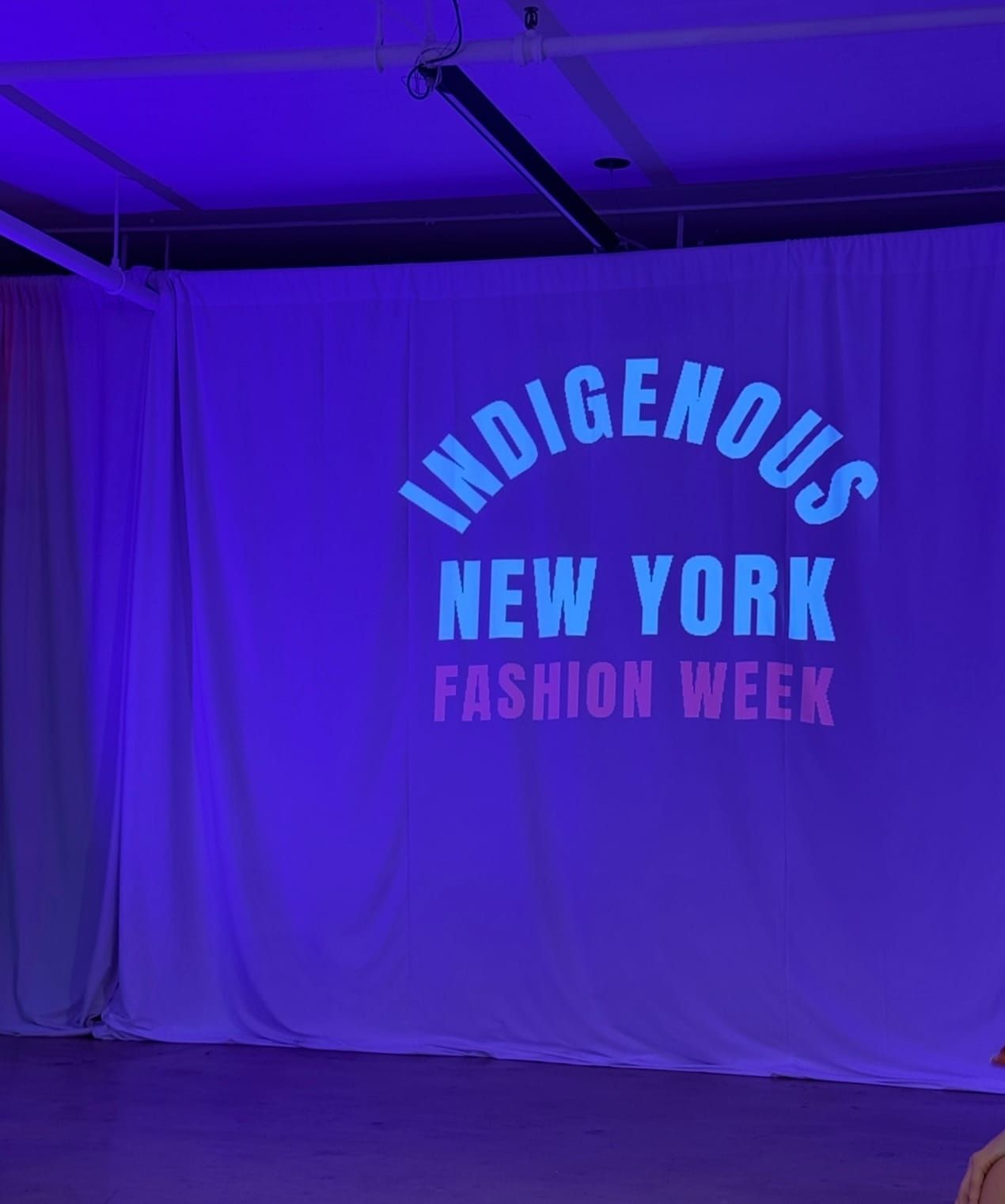
That visibility was central to the second annual Indigenous New York Fashion Week, coinciding with the long-running New York Fashion Week. The Indigenous runway shows took place Sept. 11–13 at the American Indian Community House in Manhattan’s Garment District.
Liana Shewey, a Muscogee (Creek) Nation citizen raised in Stillwater, Oklahoma, co-founded the event with Korina Emmerich, a designer of Puyallup descent. Their organization, Relative Arts, produces INYFW and operates a community space and shop showcasing contemporary Indigenous fashion and art.
“We are carving out space for Indigenous designers and models to take the global stage on their own terms,” Emmerich said.
Pat Sanabria, an Indigenous streetwear model from Atlanta and a member of the Seminole Tribe, walked for Art of Culture and Relative Arts. When asked about his experiences on the runway, Sanabria described a connection to something beyond the show itself.
“Water, fire, and I felt protected,” Sanabria said. “I felt like my ancestors and my spirit world were definitely watching me.”
The runway event featured 30 Indigenous designers and 120 Indigenous models, with more than 100 tribes and communities represented. The work behind the runway was Indigenous led too, from production and styling to hair and makeup.
During opening remarks, the founders returned to a phrase Emmerich used at last year’s event: “This is not a takeover; it’s a take back.”
Each of the six shows opened with an Indigenous performance, bringing dance and music into the program before the designers took the stage.
Tulsa-based musician Elisa Harkins, who is Cherokee and a citizen of the Muscogee (Creek) Nation, opened the two Saturday runway shows. She performed “Deadly” at Runway 3: Knowledge Keepers and two Muscogee hymns, “Espoketis Omes Kerreskos” and “Heleluyvn,” at Runway 4: Thought Leaders.
In an Instagram post, Harkins wrote that she was “so grateful to bring these songs into this space and to be part of a gathering celebrating Indigenous fashion, art, music and community.”
Raven Bright, a Diné contemporary artist and runway model from Gallup, N.M., has used dance and movement to reconnect with his culture. His Diné clan is Dibéłizhiní, or the Black Sheep Clan.
At Indigenous New York Fashion Week, Bright described that connection between tradition and contemporary expression as Indigenous futurism.
“It’s not like feathers and the old traditional way, right? The way that we move now is more futuristic. Indigenous futurism is the term I like to use, and I think that’s what we’re going for,” Bright said.
Bright framed the Indigenous fashion show as not just a runway, but a place where Indigenous expression could honor the past and look toward the future.
“We’re representing the past, the present and the future, and I think that’s beautiful to see,” Bright said. “That’s what we’re trying to showcase here, how we live for our ancestors, but also how we’re going to represent the future and the children who are watching.”
The event reached beyond the runway. The 30 designers’ showcases appeared for the first time on the Council of Fashion Designers of America’s Fashion Events Calendar, according to a news release. The CFDA organizes New York Fashion Week’s official schedule, and the shows were also livestreamed at Rockefeller Center.
Relative Arts received a New York City certificate of recognition from Mayor Zohran Mamdani for its work supporting Indigenous creatives and increasing their visibility in Lenapehoking, the traditional homeland of the Lenape people.
Indigenous New York Fashion Week closed by expanding that visibility beyond the runway, with performances, pop-up markets and community events that gave Indigenous designers, artists and musicians additional platforms across the city.
Gaylord News is a reporting project of the University of Oklahoma Gaylord College of Journalism and Mass Communication. For more stories by Gaylord News go to GaylordNews.net.