


by Troy Littledeer
FAYETTEVILLE, Ark. — There is a specific kind of sadness that a child isn’t supposed to understand. It is heavy, quiet, and usually reserved for people who have lived long enough to lose something they cannot get back.
Ken Pomeroy found it when she was 7 years old, sitting by a radio, listening to “Leaving on a Jet Plane” by John Denver.
To most, it is a standard folk ballad, a campfire staple about travel and longing. But to a young Pomeroy, it was a revelation. She didn’t just hear the melody; she felt the crushing weight of the man singing it.
“I felt sad for him,” Pomeroy said. “I think that was frame one of me being like, ‘I want to do that.’ I want to do that for other people.”
Now 23, Pomeroy is doing exactly that. She is no longer just a listener; she is a recording artist with Rounder Records, a label that has released albums by artists like Alison Krauss and Billy Strings. Working with legendary producers like Gary Paczosa, her voice is often described as warm and soothing, a grounded, earthy tone that wraps around the listener like a heavy blanket.
But that comfort can be a Trojan horse.
If you lean in close enough to hear the lyrics — specifically on tracks like “Pareidolia,” the opener of her 2025 album Cruel Joke — you find the sharp edge of a young woman processing what she calls a “tumultuous” childhood in real time. She sings about “lying in the debris” and concludes that “a cruel joke is all we can afford.”
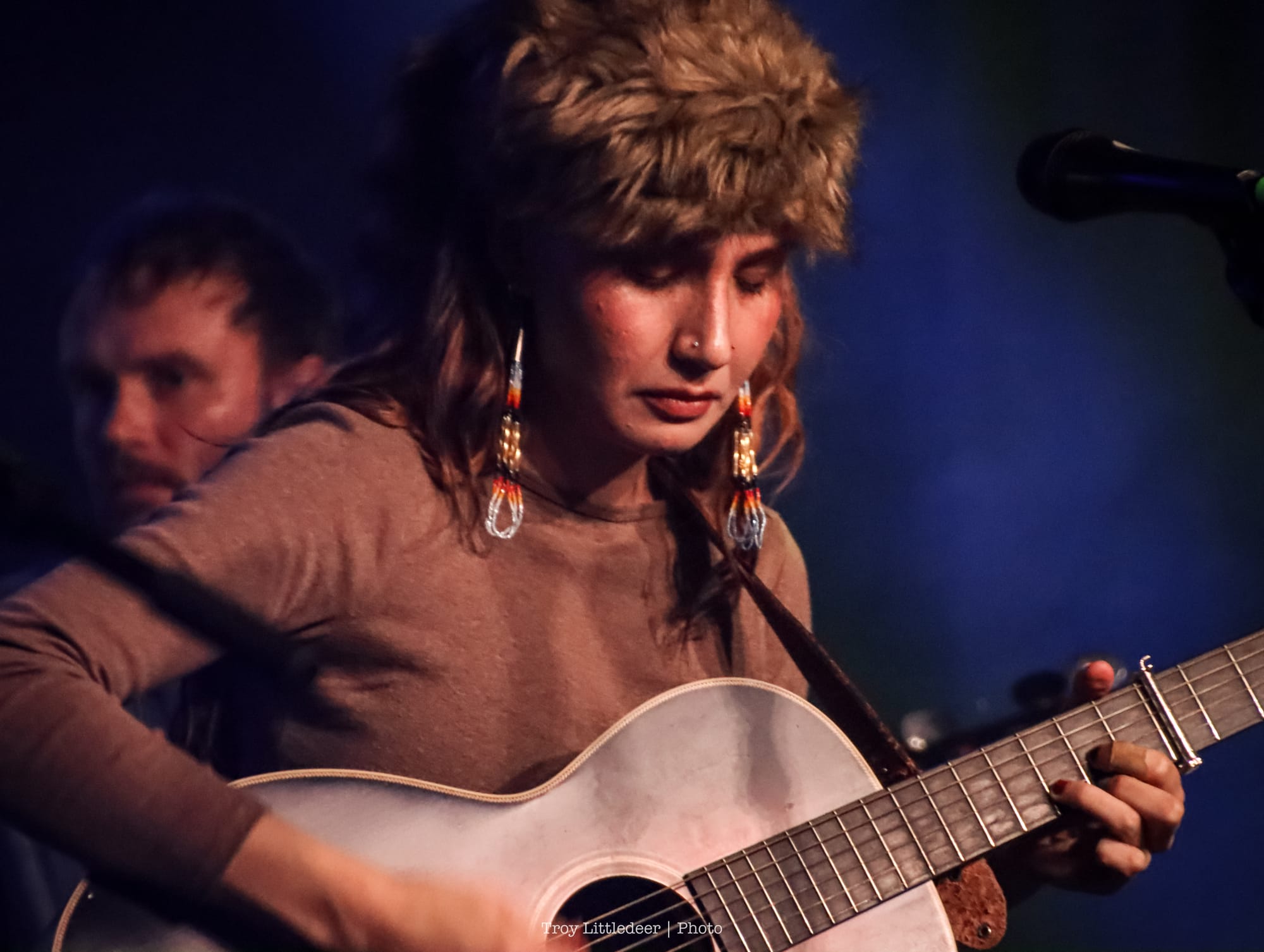
For Pomeroy, music is the place where she puts her “adult-sized feelings.” It is a container for the things that are too heavy to carry in regular conversation.
“I try to find a balance between how the music makes you feel versus how the lyrics make you feel,” she said.
She watched the first trickle of fans arrive for the Gar Hole-idays showcase at the legendary George’s Majestic Lounge in Fayetteville, then added, “And most of the time, they are very, very different things.”
In a moment of disarming honesty about that balance, she jokes that her cheerfulness in conversation might be the Lexapro talking, even while the songs remain anchored in grief. She is a professional navigating a serious industry, but she is also a young person figuring out how to heal.
The specifics of that past remain hers to keep. She doesn’t offer a detailed catalog of the wreckage, but she is clear about where she goes to rebuild.
That healing process is grounded in Oklahoma. Despite the Nashville contract and the national tours, Pomeroy’s heart remains tethered to Tulsa. She notes that 85 percent of Cruel Joke was recorded not in a high-gloss studio, but in a house she shared with her partner, Dakota. The polish of Nashville came later, but the bones of the song were built at home.
That sense of home is defined by more than just geography. It is anchored by her 90-something-year-old Mamaw, the matriarch who taught her the heritage she carries. On stage, Pomeroy paused during the introduction to her song “Coyote” to share the name her grandmother gave her: ᏩᏯ ᎤᏍᏗ (Little Wolf). It was a quiet declaration of identity that predates the music.
She does not have to do the work alone. The Tulsa music ecosystem operates more like a safety net compared to cutthroat Nashville or Los Angeles. It is a lineage-based meritocracy. Pomeroy points to Oklahoma artists such as Kaitlin Butts, Kyle Reid, and Samantha Crain as part of the community that shaped her — musicians who didn’t push her out, but pulled her in.
“Never once did I feel pushed out,” Pomeroy said. “I honestly blame a lot of my perseverance on that because it was a very strong foundation.”
Yet, the intimidation factor remains real. Pomeroy grew up listening to John Moreland on an iPod when she was 10 years old. Moreland, a songwriter known for his stoic, mysterious persona and lyrics that can level a room, was a figure that “hung the moon” for her.
The song “Coyote” carries a tension of its own. On stage, Pomeroy shared that her Mamaw taught her a coyote was a bad omen — something to be wary of. It seemed the exact opposite of the name she had been gifted, Little Wolf. But instead of running from that omen, she turned it into an ode to Oklahoma. To finish it, she took a shot in the dark and cold-messaged Moreland to ask for a harmony.
He said yes. When they eventually toured together, the transition from fan to peer was jarring.
“He’s very mysterious,” she said, laughing. “He’s very reserved… I caught myself just tripping in front of him or doing something stupid because I was nervous.”
But the nerves settle when the purpose becomes clear. For Pomeroy, a Cherokee Nation citizen, that purpose shifted into sharp focus during a recent show in Manitou Springs, Colorado. It wasn’t about the famous names on the marquee or the industry executives in the wings. It was about who was standing in the crowd.
She looked out and saw three Native people. In a sea of faces, it wasn’t a massive demographic shift, but it was a signal.
“That was the first time ever that someone came to see us,” she said. “It’s truly everything to know that, one, people are coming to see us, but also, family are coming to see us. We’re all one.”
This is the quiet engine driving her career. It is not about climbing the Billboard charts or counting the Spotify streams. It is about the “Still Here” principle — the assertion of sovereignty simply by existing in spaces where Indigenous people were once erased, or worse, caricatured.
“It’s realizing how many people don’t realize that Native people are still around and literally everywhere,” Pomeroy said. “We’re not all feathers and teepees. I guess it’s educating people like, ‘Nah, we’re still here. We’ve been here the whole time.’”